
Blog
FiveM Server Logging: The Audit Trail That Catches Cheaters and Bad Admins

Anti-cheat catches the player flying across the map with a god-mode menu. It does nothing for the admin who quietly spawned himself two million dollars, or the duper who found a stack-split exploit your screening missed, or the friend-of-a-friend you trial-modded who’s been deleting evidence as he goes. That’s the job fivem server logging does and anti-cheat never will: it doesn’t prevent the bad thing, it reconstructs exactly what happened, who did it, and when — so you can roll it back and ban with proof instead of a hunch. A server without real logs isn’t running secure; it’s just running blind and lucky.
Logging and anti-cheat do different jobs
Owners conflate these constantly and then wonder why “we have anti-cheat” didn’t stop an economy collapse. Anti-cheat is a bouncer — it watches for the obvious in real time and kicks. Logging is the security camera — it records everything, including the things that look perfectly legitimate in the moment and only reveal themselves as theft when you replay the tape a week later. A dupe doesn’t trip anti-cheat; it looks like a normal item move. A rogue admin handing out cash doesn’t trip anti-cheat; he has permission. One system prevents; the other reconstructs. You need both, and most servers massively under-invest in the second one.
What you must actually log
The default trap is logging too little of what matters and too much noise. These are the categories that earn their keep, and every one of them should be on from day one:
- Money, every movement. Cash and bank deltas, who paid whom, payroll, store purchases, ATM in/out. The single most important log you have for catching exploits is the money trail.
- Item moves and dupes. Inventory transfers, drops, stashes, crafting, and especially item creation events. A dupe shows up as items appearing without a corresponding source — you can only see that if you logged the source side too.
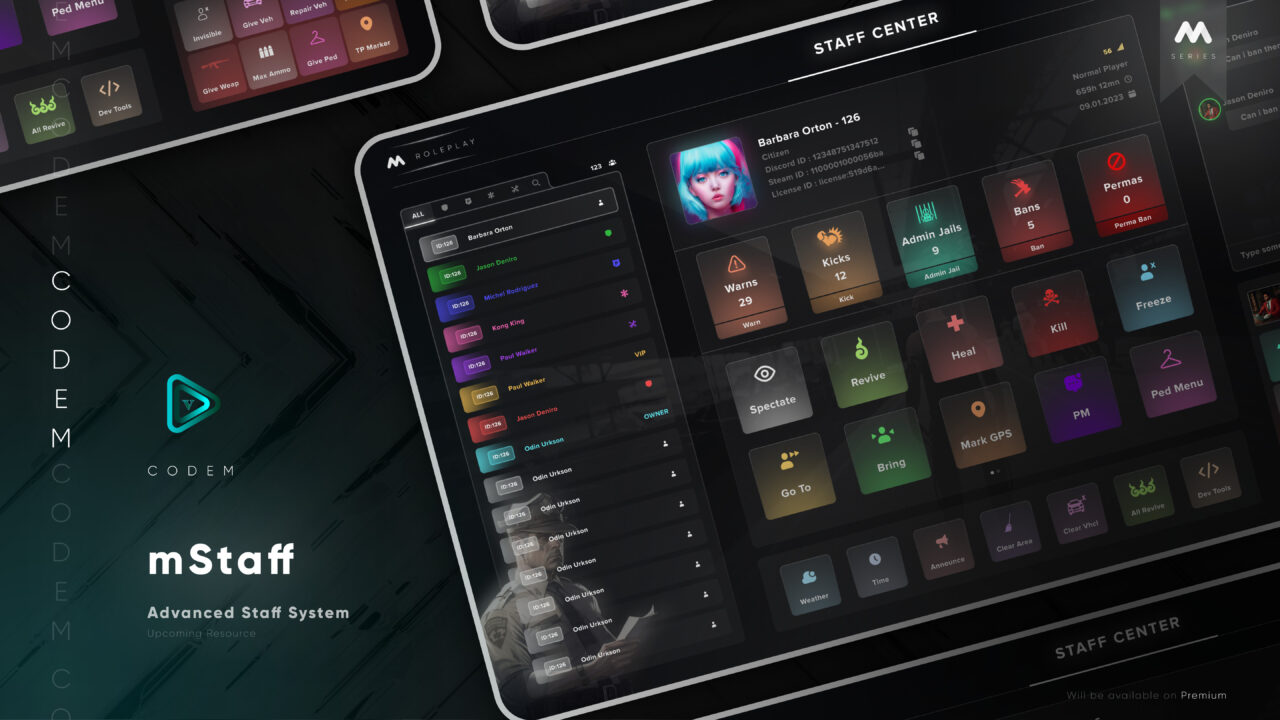
- Admin actions. Every spawn, every setjob, every give-money, every noclip and teleport, every revive. Admins are the highest-trust accounts on the server, which makes them the highest-risk. Log them harder than players.
- Joins, leaves, bans, and identifiers. Capture license, Discord, Steam, and IP on connect. When you ban one account, identifiers are how you find the other three it was wearing.
- Kills and deaths. Who killed whom, with what, where. Essential for adjudicating combat-log and RDM reports.
Discord webhooks: the cheap searchable backbone
For 90% of servers, Discord webhooks are the right logging backbone and you should not feel bad about it. They’re free, instantly searchable with Discord’s own search, and let your whole staff team read the trail without SSH access. The pattern that works: one channel per log type. A money channel, an inventory channel, an admin-actions channel, a connections channel, a kills channel. Cramming everything into one feed makes it useless the moment it scrolls.
The reality to plan around is rate limits. Discord caps webhook throughput (roughly 30 messages per minute per webhook before it starts dropping or queuing), so a busy server will lose log lines if every event fires its own POST through one hook. Use separate webhook URLs per channel, batch high-frequency events where you can, and never route position spam or per-tick noise to Discord. If you want to pair this with admin-side action history, txAdmin keeps its own log and the breakdown of those action logs on cfxre-tebex.io is a good companion to your webhook feeds.
Recommended FiveM scripts for your server




Structured logging when webhooks aren’t enough
Webhooks are great for reading; they’re poor for querying at scale. Once you’re a large server, “find every transfer over 50k between these two licenses last Tuesday” is a question you cannot answer by scrolling a Discord channel. That’s where structured logging earns its complexity.
- Framework logging. Most servers already have qb-log or an ox-style logger wired into their framework — the trouble is owners install it and never actually route the important events through it. Make sure your money and inventory scripts are calling the logger, not just printing to console. The qb-log setup and what to feed it is documented on qb-tebex.io.
- Ship to a real store for big servers. Push structured JSON to a proper log store — a Grafana Loki stack, an ELK setup, or even a dedicated MySQL log table — so you get real querying, filtering, and retention. This is the difference between “I think it was him” and a filtered table proving it. If you’d rather buy than build, the dedicated logging scripts and resources on scripts-tebex.io handle most of the plumbing for you.
- Custom events. Anywhere you have a script doing something money-adjacent that no logger covers, add a log call. Five minutes now versus an unsolvable incident later.
Searchable, retained, and read after the fact
A log you can’t search or that rolled off three days ago is decoration. Two rules: make every line structured and identifiable (include the player’s license and a timestamp on every event, not just a display name someone can change), and retain long enough to matter. Most serious incidents surface days or weeks after they happen, so a 24-hour retention window is useless — keep money and admin logs for at least 30-90 days.
The payoff is the post-incident read. A dupe report becomes: filter the inventory log for that item ID, find the moment count jumped without a source, pull the license, cross-reference the money log to see where they cashed it out, check connections for their alt identifiers, and ban the set with a screenshot of the trail. A “an admin gave my friend cash” accusation becomes a filter on the admin-actions channel that either confirms it in ten seconds or clears the admin instantly. That speed and certainty is the entire reason logging exists.
Upgrade your server — shop our FiveM scripts





The cost and the alerting upgrade
Logging everything isn’t free. Per-event database writes and webhook calls add overhead, and routing high-frequency events synchronously can stall your server thread — keep log writes async and never log per-tick. There’s a privacy dimension too: you’re storing IPs and identifiers, so retain deliberately, restrict who can read connection logs, and don’t hoard data you’ll never query. Finally, the upgrade that turns logs from forensic into preventive: alert on anomalies. A single transfer over a sane threshold, item creation outside known sources, or one admin issuing a burst of give-money commands should ping a private staff channel the moment it happens — not wait for you to go scrolling. Anti-cheat tells you someone’s flying. Good fivem server logging, with alerting on top, tells you someone just printed a fortune three minutes ago and exactly which account to reach for. Build the audit trail before you need it, because you only ever realize you needed it after it’s too late to start.